
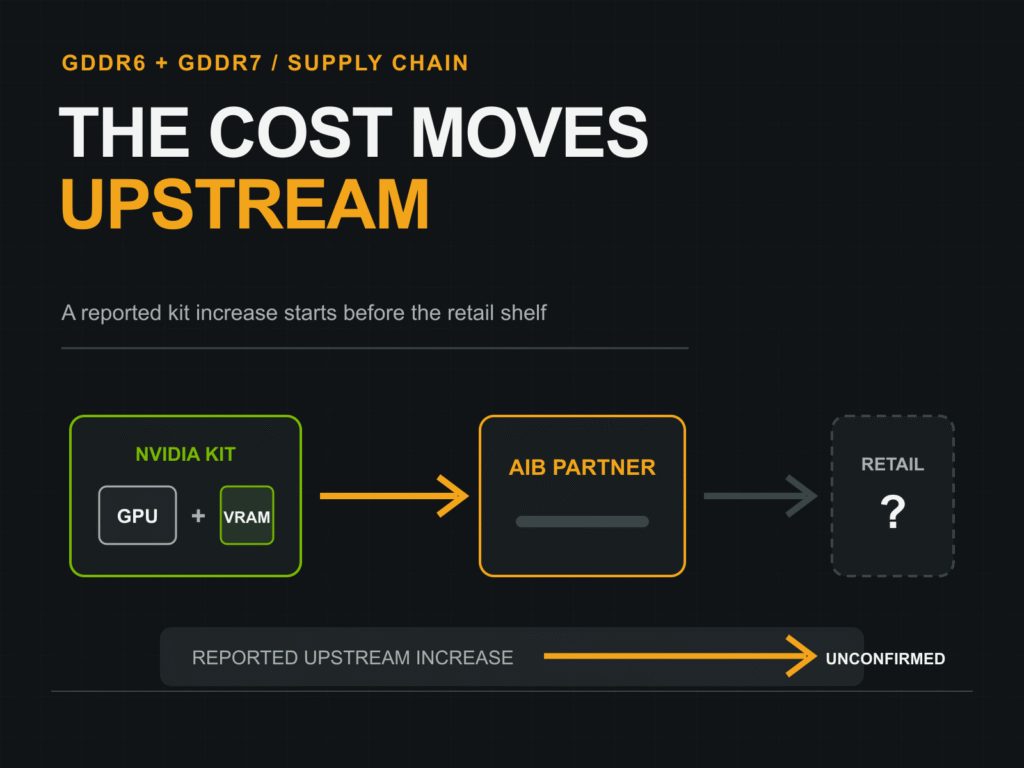
NVIDIA reportedly notified add-in board partners of higher prices for GPU kits containing both the graphics processor and its memory. The report appeared through BenchLife on July 23, 2026 and says the adjustment covers GeForce products using GDDR7 as well as older GDDR6.
This could eventually make graphics cards more expensive, but that outcome is not confirmed. NVIDIA and its board partners have not announced new retail prices, the size of the reported increase or a list of affected models.
What has been reported
VideoCardz's July 23 report attributes the information to BenchLife and explicitly labels it as a rumor. According to that account, NVIDIA supplies board partners with the GPU and graphics memory together as a kit, and partners have now been notified of higher kit costs.
The report also says cooler, PCB and packaging costs are increasing, although memory remains the larger pressure. It does not provide exact prices or identify particular GeForce cards.
| Reported | Still unknown |
|---|---|
| GPU-plus-memory kit costs increased | Size of the increase |
| Both GDDR7 and GDDR6 products are included | Exact GPU models |
| Board partners received notification | Regions and effective dates |
| Other board costs are also rising | Resulting retail prices |
That second column is why headlines claiming an immediate GeForce price increase go too far.
A board partner does not simply buy a loose GPU and choose any available memory. GPU vendors qualify particular memory devices and board configurations around signal integrity, timing, capacity and firmware requirements. Supplying the GPU and VRAM as a kit gives NVIDIA control over that pairing.
It also means an increase in graphics-memory cost reaches the board partner through NVIDIA rather than appearing as a separate retail DRAM purchase. This is relevant to the reported delay around higher-capacity RTX 50 Super cards, which we covered in our July 2026 GPU rumor analysis.
Board partners and distributors already hold inventory purchased at earlier costs. Those cards do not become more expensive to manufacture retroactively.
A partner can also absorb part of an increase, reduce promotions or adjust the mix of premium and basic models before changing the visible price. Distributor inventory and regional demand add further delay. PC Gamer's July 23 coverage notes that existing stock and already-thin board-partner margins pull in opposite directions.
The likely retail effect, if the report is accurate, would therefore appear unevenly. One model may lose a discount while another receives a new list price. Regions with low inventory could move before markets with deeper stock.
What it means for buyers
GDDR7 points naturally to the RTX 50 generation, but the reported inclusion of GDDR6 makes this more than a Blackwell story. GeForce products from other generations and lower-end configurations can still use GDDR6.
That does not prove that every such card is affected. It means buyers should watch individual model prices instead of assuming older inventory is insulated from the same memory market.
The broader memory squeeze is already affecting consumer hardware. Our DDR5 price analysis explains how AI and server demand can redirect manufacturing capacity and raise costs far outside the data center.
This report is not a reason to panic-buy a graphics card. There is no confirmed deadline after which every GeForce model becomes more expensive.
A better response is to record the current price of the exact card under consideration, including the seller and whether it is first-party stock. Then watch that same model rather than a category average. A disappearing promotion is meaningful; a rumor repeated across several sites is not a price measurement.
The next useful evidence will be revised partner price lists, distributor notices or a sustained change in tracked retail prices. Until one of those appears, the careful conclusion is narrow: NVIDIA reportedly raised an upstream cost, while the consumer effect remains unconfirmed.