
I have been buying NVIDIA flagships for a long time, and the decision was never complicated. When the GTX 1080 launched in May 2016, I was running a GTX 980, and I ordered the 1080 essentially immediately. Not out of impatience; out of arithmetic. Period reviews measured the 1080 at 60 to 100 percent faster than the 980 depending on the workload, DirectX 12 tests at the top of that range, all in the same power envelope, for a $599 MSRP ($699 for the Founders Edition). A card that nearly doubles your frame rate for last generation's price is not a purchasing decision. It is a formality.
Today I run an RTX 4090, and for the first time since I started this hobby, the flagship above mine is a card I have no reason to buy. I want to lay out why, with numbers rather than mood, because I think my situation generalizes to most of the enthusiast market right now.
The card I am supposed to want
The RTX 5090 is, by every review I trust, the fastest gaming GPU ever made. It is also, for my purposes, a bad product. Tom's Hardware measured it about 25 percent faster than my 4090 across their 4K rasterization suite; other outlets got closer to 33 percent at native 4K with different game selections. A quarter to a third more performance. Against that, the price: the 5090 launched at $1,999 MSRP and has actually touched that number, since Tom's Hardware's price tracker records $1,999 as its lowest-ever US street price. But on July 20, 2026, the best available US price was $3,749. Our own Market Watch logged the same number, and PC Gamer's UK price watch had it at £3,320 on July 16. Here in the EU the situation is worse: the boards I actually see in stock land in the four-to-five-thousand-euro range once VAT is counted.
So the offer on my desk is: pay roughly double the card's official price for a quarter to a third more frames, on a card I would also need to feed 575 watts. I compared that to 2016, when I paid $599 to nearly double my performance, and closed the shop tab. I do not think I am unusual. I think every 4090 owner has run this same arithmetic and reached the same answer, and that is new. There has never been an NVIDIA flagship generation where the previous flagship's owners were, as a group, rationally out.
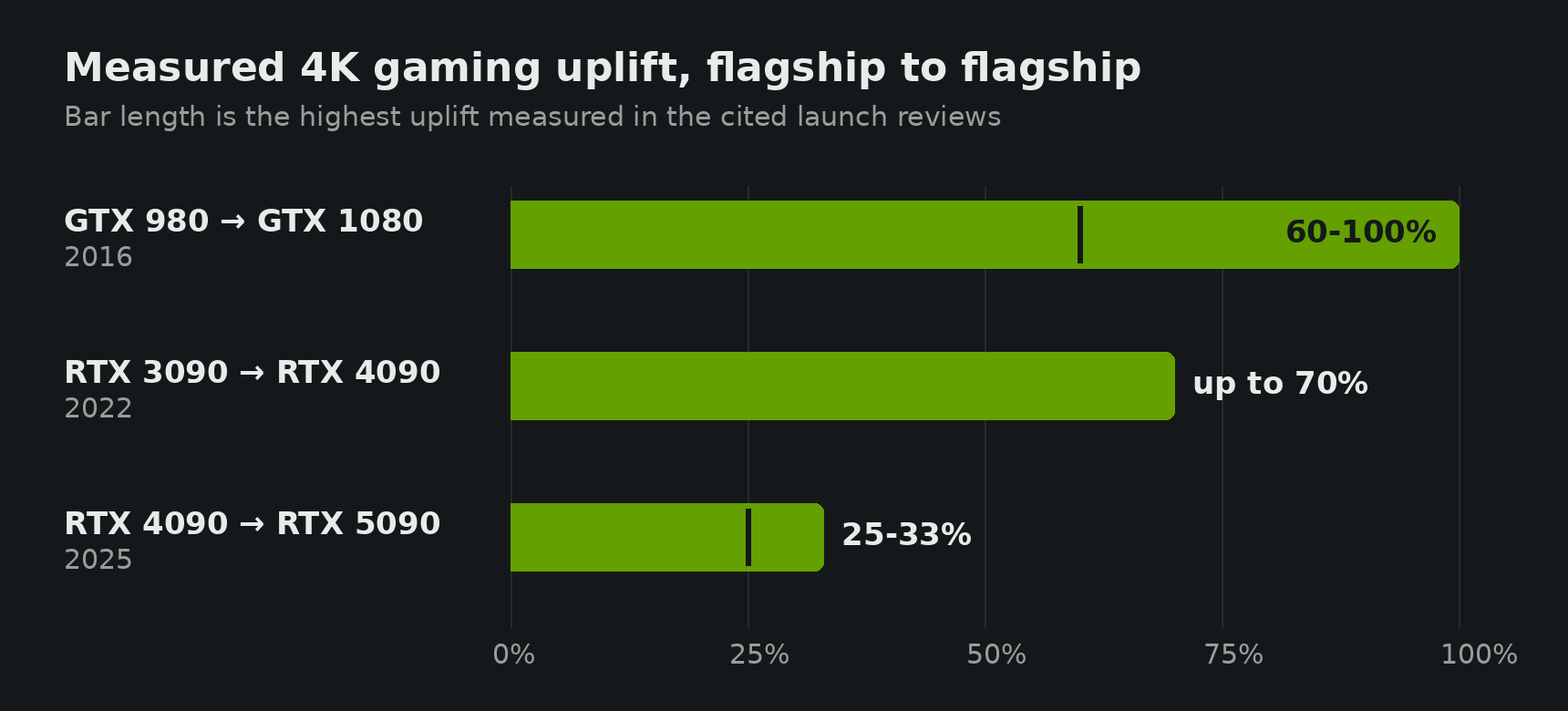
The middle row of that chart is worth pausing on, because it shows this is not simply "progress ended". The RTX 4090 I own was a genuine leap; review roundups put it up to 70 percent ahead of the RTX 3090 at 4K in late 2022. The flattening happened in one generation.
Why I do not blame the engineers
This section is my analysis, and I want to be fair about the physics before I get to the business.
Pascal, the generation that made my 1080 purchase automatic, rode a full node jump from 28 nm to 16 nm FinFET. Blackwell got no such gift: it is built on a process closely related to the one my Ada card already uses, so its gains had to be bought with a bigger die, faster GDDR7, and a power budget pushed to 575 W. When the node stops moving, that is simply what a generation looks like. The whole industry's process cadence has slowed, and no amount of goodwill toward gamers changes transistor physics.
But physics only explains the small uplift. It does not explain the price, and that is where the business comes in. In NVIDIA's most recent reported quarter, Q4 of fiscal 2026, data center revenue was $62.3 billion and gaming was $3.7 billion. The segment I belong to as a customer is about 5 percent of the company's revenue; the data center is about 91. Every GeForce die competes for wafer capacity against silicon that sells for several times more per square millimeter. I do not think anyone at NVIDIA dislikes gamers. I think nobody has to: the allocation spreadsheet deprioritizes us impersonally, every quarter, and thin GeForce supply plus strong demand is exactly what a street price sitting 87 percent above MSRP looks like.
The third ingredient is that nothing pushes back. AMD's RDNA 4 generation deliberately stops in the upper mid-range, where the RX 9070 XT is genuinely good; above roughly $700, NVIDIA competes only with itself. And when a company competes with itself, marketing fills the gap that engineering cannot: this generation leaned hard on DLSS 4 multi-frame generation, including the launch-window claim that a 5070 delivers 4090-class performance. I use DLSS and I like it, but generated frames are not rendered frames, in latency or in feel, and I would not let that arithmetic near a purchasing decision.
What the market charges while nobody competes
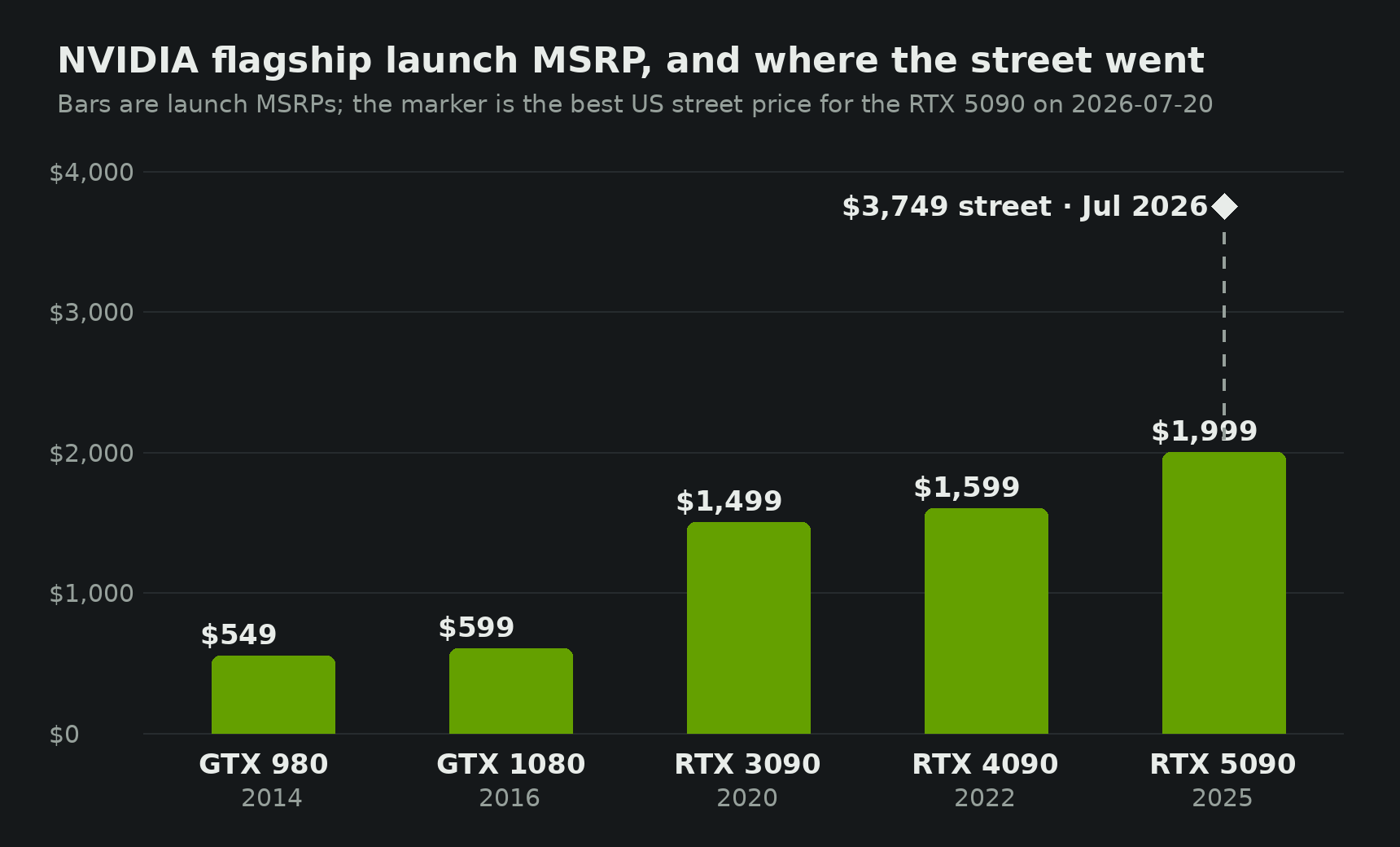
The same pattern runs down the stack, milder at each step. These are the prices our Market Watch imports logged between July 16 and 20, 2026, from Tom's Hardware's tracker and PC Gamer's price watch; each link goes to the live page, which keeps updating after this article ages.
| Card | MSRP | Best US street price (July 2026) | Lowest ever recorded |
|---|---|---|---|
| RTX 5090 | $1,999 | $3,749 | $1,999 |
| RTX 5080 | $999 | $1,256 | $929 |
| RTX 5070 Ti | $749 | $919 | $729 |
| RTX 5070 | $549 | $599 | $479 |
| RX 9070 XT | $599 | $689 | $599 |
Every one of those cards has also drifted upward over the past two months. That is not a coincidence of the GPU market alone; the same AI buildout squeezing GeForce supply is squeezing memory even harder, which I covered in the DDR5 price surge piece. The whole cost of a gaming PC is being repriced by data-center demand.
What I would do in each seat
My advice, for whatever an opinionated 4090 owner's advice is worth:
- If you are where I am, on a 4090 or a 4080: do nothing. This is the rare generation where sitting still is the enthusiast move. My 4090 still clears everything I throw at it in 4K, and I have stopped checking 5090 listings. I will revisit when there is a real node jump or a sane street price, whichever shows up first.
- On a 30-series card: the upgrade is real, but it lives in the middle of the stack. A 5070 at $599, a 9070 XT at $689, or a 5070 Ti at $919 is a big jump from a 3070-class card. Mind the VRAM: 12 GB on the 5070 is fine at 1440p today and is the first spec on that card that will age badly.
- On anything older: a current mid-range card or a used previous-generation flagship both make sense. Our tracker logged used RTX 3080 listings around $285 in mid-July, which is still a lot of 1440p rendering per dollar.
- Whatever the seat: ignore MSRP, check the street price on the day, and be suspicious of any performance claim with frame generation baked in.
The strangest part, for someone with my buying history, is the conclusion itself: waiting is currently the rational strategy. That was never true in the 980 days, when waiting just meant losing a year of performance the market was happy to sell at list price. When the fastest card on earth asks nearly double its own MSRP for a one-third uplift, time works for the buyer, and I intend to let it.
The honest caveat
Prices in this article carry observation dates of July 16 to 20, 2026, and they move weekly; the linked Market Watch pages hold the current numbers. Performance figures are native rasterization results from the cited reviews, not frame-generation composites. NVIDIA's segment revenue is as reported for its fiscal Q4 2026, ended January 25, 2026. My conclusions about upgrade timing are opinions built on those inputs, and if supply, competition, or pricing shift materially, they should be re-derived rather than reused.
Sources:
- Tom’s Hardware: RTX 5090 Founders Edition review, 4K rasterization results
- Tom’s Hardware: lowest GPU prices tracker
- PC Gamer: graphics card price watch
- Trusted Reviews: GTX 1080 versus GTX 980 comparison
- Notebookcheck: RTX 4090 review roundup
- NVIDIA: Q4 fiscal 2026 financial results
- ServeTheHome: coverage of NVIDIA’s Q4 FY2026 earnings
- Nvidia Club Market Watch: observations, July 16 to 21, 2026